17 Minutes Only!

Showing posts with label Blog traffic. Show all posts

Wednesday, 13 July 2016

4 Potent Ways to Promote Your Blog to Get More Traffic

So you’ve written a blog post. Do you sit back and wait for people to come?
Well, you could if you’re willing to wait for search engines to find it. And even then, unless you are already considered by search engines as A Very Important Website, your post is not likely to be found in the first few pages of search results as there is too much competition.
What this translates into is no traffic.
Doing a bit of self-promotion in a way that is human and adds value to others, is a great idea to increase eyeballs on your blog.
So we’ll deal with 5 ways to do this, but first let’s focus on getting the content portion right. And I only mention that because so many bloggers fail at it. But the consequence of not getting the content bit right means you’ll probably just waste your time promoting it.

Get the Content Bit Right First

What do I mean by “getting the content bit” right first?
Well, your content needs to be written for the right audience - those who will eventually buy something from you, and the content also needs to be optimized. For instance, the usual stock images won’t attract attention, so you’d need to do some customization.
I am not going to expand on the subject of content here, but Neil Patel, Internet Marketing Guru, has written a post about how to create a blog properly, and the steps about content are thorough.

4 Solid Blog Promotion Ideas

There are many ways you can promote your blog and posts, but the following four methods are some of the most potent ways to bring in more traffic, when they are done properly.
To avoid repetition in each method, every one of these points, bar paid search, requires two specific elements, the first one of which is this: all blog promoting you do needs to provide value to others. Never, ever blatantly market your wares.
The key with online marketing is:
a) to be human, and
b) to promote links in a way that’s natural; woven with grace and dignity into value-add content.
The second specific element that makes these ideas work - all four of ‘em, is that they all need to be centered around your target audience. If they are not, you will get traffic, but it won’t be the right kind of traffic. The right kind of traffic are the people that will eventually buy from you.
Traffic for the sake of traffic is, well, just plain stoopid.

#1: Link from Q and A forums

Find niche forums where you know your target audience waffle around, so that you get their eyeballs on your content.
There’s no shortage of forums online; here are four of the most popular:
  1. Quora
  2. Mosaichub
  3. Yahoo Answers
  4. Askville
When you register, make sure you complete your profile, so that people who may be interested to get in touch will know how to find you, or get more information about you.
Then go ahead and find questions you can answer, that your target audience are searching for. Provide answers that are sincere and value-add. Some answers may require brevity, while others can be mini blog posts.
Here’s an example of a value-add answer on Quora. You can see the writer has included a link to content, but has done so in a natural way that is not blatant promotion:
Skills requirements to make it work:
  • You’ve got to be a good writer

#2: Link from social media

Link to your blog posts or other value-add pages from your social media accounts. But again, only use accounts where your target audience hang out.
This method can be used at no cost, or depending on the account (some offer this function while other’s don’t) give it a boost by paying a small amount.
Because it’s such a popular method of promotion, many social media tools have been developed to make tasks easier.
The important thing with linking from social media to your blog is that you use images and/or video. Images attract attention, but they can’t just be stock images like this one:
A stock photo image can do more harm than good.
Whereas the next image has been customized. Canva is a versatile tool that can be used by people who aren’t graphic designers:
This image has been customized and will attract more attention
than stock photos on social media
Quicksprout offers a full-on social media and blogging guide as to how to do this, so I won’t go into more detail here.
Skills requirements to make it work:
  • Basic graphic design
  • Social media knowledge

#3: Link from paid search

Paid search is the only promotional method listed here that requires some financial outlay, but it’s minimal compared to offline paid advertising, so you still win, as long as your target audience is searching for stuff online.
Paid search methods include:
  • Google Adwords
  • Bing Ads
  • Yahoo Search Ads
The most difficult part of paid search is choosing keywords that people use to find whatever you’re offering.
Use paid search to send people to a blog post, or if you’re having a promotion for instance, you’d need to set up a landing page to send traffic to. A landing page is a dedicated, standalone page that contains no distractions and is very focused on getting the reader to perform one action. You’d use a landing page if you wanted higher conversions.
Get the lowdown on paid search and how to do it with Wordstream’s helpful “how to”.
Skills requirements to make it work:
  • Keyword research
  • If using a landing page, you’d need these skills: copywriting, graphic design, technical know-how. Or hire a pro.

#4: Comment on other blog posts

Probably the simplest method of all, is to simply add a comment on other blog posts in the same niche.
At the risk of being repetitive...make sure your comment adds some kind of value, otherwise it won’t attract attention.
Here’s an example of a value-add comment made on Neil Patel’s blog:
Skills requirements to make it work:
  • You need to be a decent writer, because your comment represents your brand

In Conclusion

Once you've published a blog post that's been written for the right people, there are ways to get the news "out there" so that search engines index your content faster because of the links from other big sites, and also to get more eyeballs to your blog, but you always need to add value to readers, and add links to your blog in a natural way.
Always focus on your reader so that you provide content that is useful.

Tuesday, 5 April 2016

8 Easy Steps to Take Your Website From No Traffic to Non Stop Visitors

5c334374-5d0f-4095-b8b3-3b33670f4163Guest post from Corianne Burton from N2Q Consulting
So, you have a website and – you’re proud to say – it’s a sharp one. Now what? Although it would be great if they did, visits don’t always just start rolling in on their own. Oftentimes, it takes strategic planning and careful attention to get the ball rolling at the speed you’d like.
Many of these efforts and checkpoints you can implement right away, on your own. Some of these foundational tactics take a bit longer to see a return on, and it would be best to bring on a professional to oversee the process – but they are worth the extra effort, up front (I’m looking at you, SEO). Here are 8 easy steps to start increasing your traffic, today:

Test drive your website

First, before you try anything else: think like a user that has no prior knowledge of your company and start clicking around. Take note of any external and internal links that might be broken, or pages that might lead you in a frustrating circle. Make sure that every time you click to a new page of your site, there’s a way to get back to where you started, or a clear call to action to keep you moving on. Subscribe to your own blog, send yourself an inquiry on your contact form, and complete a test order if you have an ecommerce site. It’s imperative that you have firsthand knowledge of your site flow, and are confident in the paths you are setting out for users to take.

Go organic

Search bots scan your website and report what they find back to the search engines. This lets the search engines know what content you have on your site, so they know what sort of organic (unpaid) searches to send your way. Google is all about user experience and intention, and providing results that meet the need of the query. If you provide exceptional, unique content that shows Google you know what you’re talking about, they’ll respond accordingly. You can optimize your site for important keyword phrases and organic traffic by updating important metadata, but you should also be identifying your target audience and researching your competition to find important keyword opportunities you could be missing out on. Doing this helps you to know where you currently stand in terms of organic traffic and opportunity, where you can optimize your messaging to better attract that specific audience, and where your competitors are at in this same process.

Start a blog

Your company should have a blog, and here’s why: Google loves thought-leading content that establishes you as a resource in your field. You should update your blog frequently, and consistently, and you should appeal to your target audience with unique, innovative content that meets a specific need – don’t just republish industry news or press releases, although some of that works, too. Ask yourself: what would your customers want to read? Determine what keywords are sending traffic to your site, find the demand in your line of work, and create an editorial calendar around those topics. Then, get to consistently publishing so Google will take notice.

Get your name out there

Publishing articles on other relevant websites is a great way to build your industry connections, reach a new audience, and drive new traffic to your site. You just need some time, applicable industry research, and a well-written email to show others the value in a content partnership with your site. Look for sites that are part of your industry without being direct competition; readers can check out the article and come straight to your site for further engagement or to reach out with questions.

Engage your social media following

Add social share buttons to your content. This makes it easy for readers to share your content with their own audience and get the conversation started (or keep it going) on social media. You can track your social media referrals in Google Analytics, so pay attention to which outlet has the best return and invest some money into promoting posts or pins or tweets, accordingly.

Check out popular industry websites

Reach out to industry websites that receive a significant amount of traffic and establish a connection with them. Compliment this mission, their messaging, their product, or their approach. Ask about getting added to a directory they have, or to include you in a list of partners or trusted resources. You can also visit the website’s blog and leave some genuine, engaged comments on their articles. This is an excellent way to push traffic to your site.

Join an affiliate program

Affiliate programs work to promote your business to their networks. For each sale your website receives through the affiliate program recommendation, you pay a small fee.

Utilize pay per click advertising or email marketing

Although not ideal for consistently driving a substantial amount of traffic, Google Adwords pay-per-click (PPC) advertising is a great investment for some immediate and targeted traffic. If you’d rather not invest additional resources into ads, have an option for visitors to sign-up for a mailing list. Send out newsletters, opt-in incentive for free products, or time-sensitive coupons for subscribers. Each email or newsletter should refer readers to your website for additional information.
If it were easy, everyone would be have thousands and thousands of unique visitors every single day, but it’s all about determining what works best for you in your industry. We highly recommend starting from the top of the list, and working your way down. Sound off in the comments – we’d love to hear what’s worked for you!

Saturday, 2 January 2016

An Easy Way To Get a 205% Boost In Search Engine Traffic

Your TITLE on your blog posts can make a huge difference to your rankings.
You know you need to rank.
You need that ‘google traffic‘.
It’s how you’re going to get leads cheaply, and for a long time, so it’s important to know as much as you can about SEO.
What if I told you that you could improve your rankings by changing a couple of words in your title?
You can. It’s easy, I’ve done it.

how to boost search engine traffic
Well, to start off with let’s think about how Google ranks pages.
Google ranks pages to match up to people’s search terms. Terms which, by the way, are ever changing. As society changes and trends rise and fall the WORDS people type into search engines change.


In order to stay always on top you need to show Google that your site is better than all of the others. Content is part of this situation.
Your CONTENT, that is the actual ‘stuff’ on your page needs to be great. It can’t be mediocre in today’s world. It needs to be unique, interesting, helpful, easy to read and free. So you work hard to get all of that stuff on the page, and usually what happens is you give it an average title.

Your Blog Post Title

Now, the title of your blog post can be argued to be THE most important thing about your post. Why?
It’s the first, and in many cases the last thing your readers will ever see about your blog. If someone sees your title in the SERPS and doesn’t click it, that’s very bad. Your title needs to draw people in like a magnet.
Now, what invariably happens is that as people learn about online business, SEO and so forth, they’ll have it drilled into them that ‘keywords are key’ and you need to put your keywords in your title, somewhere near the start.
This is somewhat true, but what’s even more important?
Well sure keywords are important.
You should always have the keywords you want to be found for somewhere on your page, preferably more than once and in different formats (meta tags, alt text, headings and in content) but if no-one clicks your page then it doesn’t matter.
If people are clicking OTHER sites over yours, and they KEEP doing this, then after a while your site sinks down further, and this in turns gives you less chance to be clicked on and it’s a horrible cycle to get into.
You want to make sure that when Google ‘tests’ your site (they show your site nearer the top for a short period of time to test how many people click it and like it) it performs well.
Google has been known to show new sites or posts higher in the search results for a short period of time to test the click through rate, and how long people stay on your page. If your content is great, they should want to stay on there for a while, right?
But they won’t get there in the first place if your title isn’t good enough.

A Case Study

I’ve got a niche website which I don’t want to reveal here as it’s not relevant to internet marketing but just by adding a number to the title, I increased the click through rate to WAY above the average and within a few weeks it was raking number one.
Not only that, but it was ranking number 1 ABOVE sites that had MORE links, MORE content and MORE social shares.
How Does That Happen?
Because more people (by far) clicked my post over the other ones, and when they got there, I had great content which kept them interested enough to keep reading. Click through rate is very important.
So, what was the title?
Without giving the niche away, I had a keywords which was very similar to this –
‘things to do in XXX’
‘XXX’ is my niche.
So my blog post TITLE was this –
“40 things to do in XXX, especially number 5”
Now, all of the other posts for this keyword has the keyword in the title in one way or another. None of them had my little addition of ‘especially number 5’.
People saw this (at the time it was raking on the second page, and then a few days later, bottom of page 1, then now the first result) and clicked it because they were curious.
They wanted to know what ‘number 5’ was! Then when they clicked there, they stayed to read because I had written a great article.
That ranking is still staying there. I’m still the number one post for that search term and several related ones and I’m ranking above other better sites. It’s been several months now and nothing’s changed. Maybe my competition haven’t thought about changing their title?
Okay, so we understand that titles are important.

So What Makes A Great Title?

Several things.

1 – Your Actual Keyword

This is important so that people know your post is about what they’re searching for, and it helps search engines to show your post at the right time
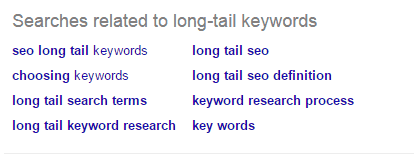
searches related to keywords - feature of Google

2 – Some Engaging Words or Phrases

Things that turn the experience from someone searching a load of random posts to a conversation. Think along the lines of if you were talking to a friend.
You wouldn’t say ’15 pictures of cats’ you’d probably say something like ‘Look at these pictures of cats, the last one is hilarious!’
Blog-Title-generator

3 – A Number

Numbers have been shown to increase click through rates. People like specific numbers.
For example, which one are you more likely to click on –
‘How to make money online’ or 
‘How I Started Making $4567.70 per hour from my room’
It makes it more relatable and interesting.
So that’s it for now, but next time you writer a blog post, think about the title you’re going to give it. Great titles can help your article get that boost it needs.


Important Note!

Make sure that no matter how great your title, your content is even BETTER. If you have a great title but terrible content then people will click on your site, then instantly click back to the search results.
This sends a signal to Google and after not too long they’ll put your further and further down the list. It’s known as ‘pogo sticking’ when a searcher jumps from your site right back to the search results and it tells the big G that they didn’t find what they were looking for.


What do you think?
Are you working hard on your blog post titles?
Please share your views in the comments below, thanks!

Monday, 9 November 2015

10 Ways To Get More Traffic To Your Blog Now

Every blogger will attest to this; It is very simple to create a blog. However, it is hard building it to get a sizable traffic. Any blog without traffic is not useful at all no matter the caliber of its content. It is so important to look for ways to gain traffic to your blog. May it be a corporate blog or personal blog; those seeking to monetize or to pass on information the readers through blogs must bring in web traffic first. Here are some ways you could bring in traffic.
Traffic Generation

1. GET INVOLVED IN AREAS WHERE YOUR AUDIENCE IS PRESENT ONLINE

Just like advertisers, you should know where to find your target audience online. Get to know the forums, websites and social communities where they are found. Several web-based tools can help you accomplish this. You are then able to interact with your audience in these platforms. For example, you could carry a message in a forum or a social site with a link back to your blog. It is highly probable that one of the readers will get interested and visit the blog.

2. TARGET THE AUDIENCE WITH THE ABILITY TO SPREAD THE WORD

Try to target the audience that is likely to evangelize your blog. Different groups would be more or less energetic to pass on the message to others. For example, content with infographics, videos and appealing photos would be best targeted on tech savvy groups that are very active on the net.

3. MAKE USE OF SOCIAL MEDIA

Social media programs have attracted hundreds of millions of accounts. Such platforms as Facebook, Twitter, Pinterest, LinkedIn, Google+ among others have such a huge following that if well-managed, you could get a vast amount of traffic to your blog. Open an account at the relevant platforms, write good excerpts and link them to your blog. Keep making friends and posting interesting stuff.

4. ANALYZE YOUR TRAFFIC

It is good to know where your traffic is coming from. Analysing the origin of the traffic will help you duplicate the efforts in future to achieve even better results. Concentrate more on sites that are bringing quality traffic. You can tell this by the amount of time that the readers are staying at your blog. Google Analytics is one of free analytical web tools you could use.

5. USE GRAPHICS AND PHOTOS

Try to make the experience of visitors to your site enjoyable. Adding graphics and photos would add a good twist to your blog experience. Ensure that they have back linking licenses. Visitors share this out (of course it links back to your blog) among their friends pulling in more traffic to your blog.

6. RESEARCH ON LIKELY KEYWORDS TO YOUR TOPIC

Keyword search helps you know what words internet users make use of when searching for related topics. It helps you use similar terms and words around the popular keywords. This increases the chances of getting a higher ranking in search results. Write a high quality article while using the keywords. However, avoid overusing keywords as they make your article look more or less like spam.

7. CREATE AN EMAIL SIGNATURE

A signature helps you tell others about your blog in a soft, less pushy method. It is simply a link put in signature settings of your email address. Unlike manual methods, you can assign an email signature and send a link to your blog in every email you send effortlessly. Try changing the style of your email signature to avoid people becoming blind to it.

8. MAKE USE OF COMMENTS SECTION

It is advisable to make great comments on other blogs. This is likely to interest readers who will click-through our details to your blog. Likewise, interact with great comment on your blogs. This way you are likely to make friends that will bring on valuable referrals to your blog.

9. ENABLE AND ENCOURAGE SUBSCRIPTIONS

Without subscriptions, there is little likelihood that visitor that who likes your posts will trace your blog in future for more posts. Subscriptions are a way of encouraging those that like your blog to visit when you put a new post. With time, you will grow consistent followers for your blogs. This is especially helpful when you’re promoting an affiliate business.

10. DESIGN YOUR BLOG ATTRACTIVELY

Visitors are likely to like your blog based on their ‘feel’ of your blog. A crisp, attractive blog is likely to get their attention and therefore receive more shares. Ensure that it is easy to understand and navigate.

Tuesday, 23 June 2015

4 Action Steps To Take Your Blog To The Next Level

blog tips
You’ve built a website, have a blog and now you’re wondering the question everyone asks: how do you get people to read it and share it? Having a blog is step one, writing irresistible content that gets shared is step two–so just how do you do that? Here are four tips that will help you take your blog to the next level.
1. Write headlines that people can’t resist. This is the dealer breaker most people over look. If you have a great post, but no one clicks on it, what’s the point? Work on writing clickable headlines. Think in terms of templates such as lists posts like “5 Reasons Traveling Changes Your Life,” or how-to posts such as, “How to Find out What Social Media Channel You Should Be On“ or round-up posts that interviews several experts in your field such as “Expert Social Media Tips to Consider as You Build Your Startup Brand.” Need ideas for inspiration? Check out Buzzfeed they are masters of writing a headline that gets read and shared.
2. Only write content that solves problems or answers questions. Why? Because this guarantees you are adding value. And when you add value, you become valuable and so do your posts. (Click to Tweet!) That doesn’t mean they should be boring. The ideal post combines solving problems while being entertaining. Think of your blog posts as a forum to share all your wisdom and knowledge you would with a mentee. Give them the good stuff, the high value advice and tips that have changed the game for your business or career. Bonus points if you can cover a topic from a new angle that has not been written about yet.
3. Be genuine, transparent and honest. People can spot a fake a mile away, so just be yourself. Own your voice, your style, your mission and company’s values. You will stand out from the crowd when you can craft a message and people can tell it’s from you or your company. Do you have personal or business mistakes or lessons you’ve learned that you can share that will help others? Those insightful blog posts have huge value especially if you can guide people from making the same mistakes.
4. Tell stories. People remember stories much easier than straight up facts. So if you can incorporate a storytelling component into your posts whether personally or professionally, you will have created a post that resonates with people and that they can connect with while adding value.
Remember to be an authority by providing content on new trends in your industry and offering insights and perspectives outside of the norm.

Wednesday, 10 June 2015

10 Ways to Bring More Readers BACK to Your Blog

10 Ways to Bring More Readers BACK to Your Blog
Bringing in new readers is an integral part of blog marketing: It’s not enough to create awesome content – You need to spread the word for more people to discover your site.
However attracting new readers is not enough: You need to bring your current readers back too. In our era of information overload, no matter how awesome you are, your readers are most likely to forget about your blog unless you keep reminding them that you exist.
Your existing readership is what powers up your blog: Repeat users are more likely to interact (because they already know you) by sharing your articles and leaving comments. Therefore, you must never let your readers forget about you!
Here are 10 ways I am keeping with my readers in touch:

Always Look for More Ways to Build up Your Email List

Building up your list is the most efficient way to keep in touch with your readers: For example, you can auto-distribute your articles to that list driving them back to your site again and again.
We’ve talked about generating leadsa lot but it’s never enough. The thing is, there’s no single recipe for how to generate more subscribers: It all comes down to lots of experimenting, tweaking, and creative brainstorming.
Here are few ingenious ways to experiment with to gain more subscribers:
1. Build up your list using your email signature.
People who are emailing back and forth with you are very much used to hearing from you. They become perfect subscribers who’ll feel more like interacting with your emails.
Besides, emailing is the least monetized effort: For example, I send replies to about 50 emails a day (responding to pitches, giving free advice, helping people connect, etc). None of that effort is in any way marketed (The only benefit is building my connections). So why not try to get more out of that since I am already spending my time emailing daily. I use WiseStampto create those calls-to-action in my signature.
Wisestamp - 10 Ways to Bring More Readers BACK to Your Site
2. Set up a giveaway
A giveaway is another absolutely awesome way to generate some new subscribers: Who doesn’t love free staff?
If you don’t have a product of your own to give away, partner with some brand (There’s a monetization opportunity out there too!)
Tomosonis one of the most legit and valuable sites when it comes to finding brands to partner with on giveaways and list building. Just search it for [giveaway] and then filter by category:
Set up a giveaway - 10 Ways to Bring More Readers BACK to Your Site
3. Host free webinars.
This is one of the most efficient ways to build up leads. Apart from building great content, developing informative webinars is an excellent way to keep your audience coming back. You can deliver value by sharing your expertise through live and recorded webinars with ClickWebinar, which provides a venue for online video conferences and webinars across any platform.
Webinars let people register (so they can opt in to hearing more from you when registering). Plus people who come to your webinar get to know you well, so they are more likely to recognize your emails and react positively to all of them. Hosting a webinar is one of the most effective site monetization methodstoo. So you can build up your list and make money as well once you get a bit comfortable with the process.
4. Use Leadshare.
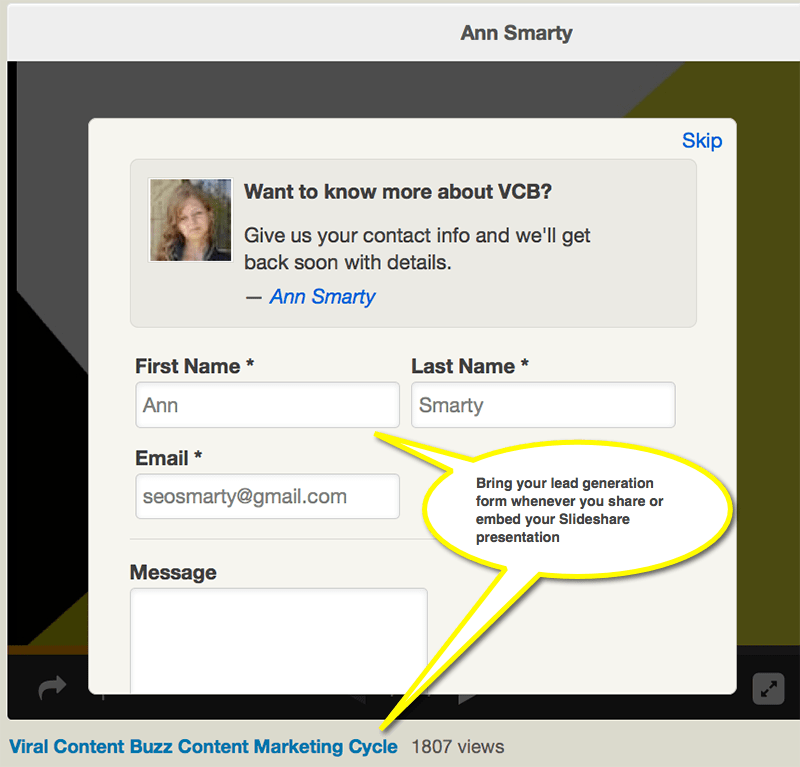
The free service by Slideshare lets you overlay your slides with a lead generation form. I love the fact that it’s so well integrated: The forms are preserved when the Slideshare content is embedded (so you can basically bring those forms whenever you cover the topic again), when you add that Slideshare to your Linkedin account, when you add that Slideshare presentation to your long-form Linkedin article…
Bringing your form into Slideshare is a great way to cater for more marketing channels and generate leads from outside of your blog.
Leadshare - 10 Ways to Bring More Readers BACK to Your Site

Optimize Your Blog Comments (WordPress)

With all the different comment management options out there, I still prefer WordPress built-in functionality. The reasons are plenty… To name just a couple of more important ones:
  • I like owning and hosting that content (For example, Disqus works great for notifying people of new replies, but with the new dashboard, you don’t really need to go to the actual article as you can like and reply to comments from any page where Disqus is running comments. It looks a bit like traffic stealing to me).
  • I love the flexibility the multitude of WordPress plugins are offering me.
Speaking of WordPress plugins… Here are those two that help me build my blog community:
5. Give your commenters the option to opt in: I am using GetResponsebecause they have a great WordPress integrationbut I guess other email platforms have their solutions as well
6. Notify your commenters of newer comments: I use this simple pluginto send an email to every previous participant in the discussion notifying of newer comments. It’s an old one, but it’s still working for me! There seems to be a newer version, but I haven’t tried it.

Use Social Media Hashtags, Content & Tagging

It takes just a few minutes of your time to make your article more shareable and let your readers bring other people (back) in (through the use of hashtags and social media tagging). Here are the 4 tips that worked well for me:
7. Let your readers tweet quotes from your page.
This works especially well when you do an expert group interview: Let your readers tweet any participating expert’s quote and tag that expert in the tweet: That will bring that person back!
Here’s a goodexample of what I am talking about: Notice if you click any “Tweet this” box, the resulting tweet will have a person who said that already tagged in the tweet:
Tweet quotes - 10 Ways to Bring More Readers BACK to Your Site
8. Use embedded content.
Embedded content is highly engaging: It adds social media proof to your content and lets more readers spread the word. You can’t overdo with it (not to slow your page down) but it may often be a good idea to engage more readers. For example, you may embed a Google Plus update and ask your readers to tag their friends if they think they might be interested in contributing.
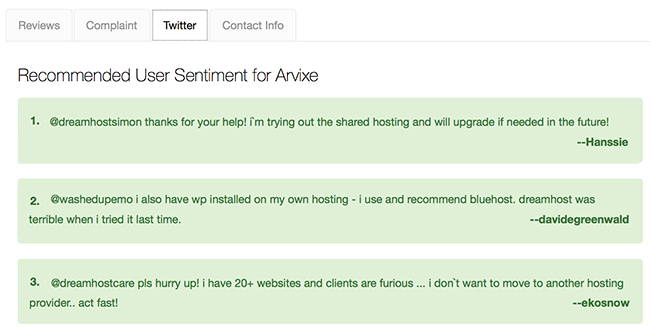
I also find that Sitegeek.comdoes an awesome job engaging users into tweeting their opinions on the listed hosting company and then using those tweets as reviews:
Tweet reviews - 10 Ways to Bring More Readers BACK to Your Site
9. Tag most important people when adding a project in Viral Content Buzz
Viral Content Buzzis the free platform allowing you to bring your content in front of social media influencers.
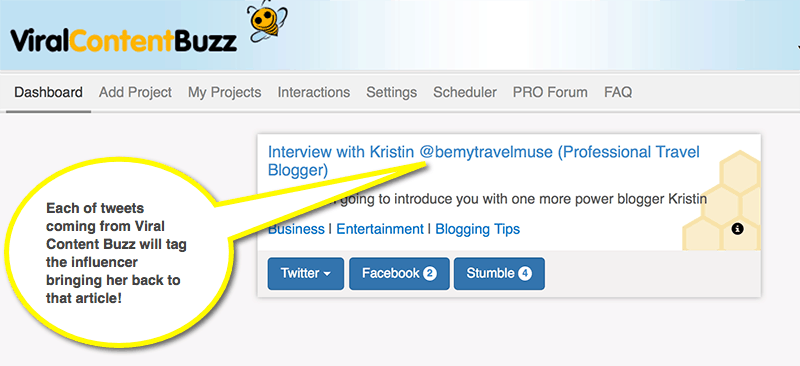
Sometimes, when I post an interview with an influencer for example, I’ll add their Twitter handle in the title or “retweet me” box and thus this person will be tagged in every Tweet VCB users create. This will prompt that influencer come back to my article again and again (to participate in the discussion or promote it again!)
Here’s the project:
10 Ways to Bring More Readers BACK to Your Site
Here are the resulting tweets tagging the interviewee:
10 Ways to Bring More Readers BACK to Your Site
10. Add the most relevant hashtag in the title of the article.
The thing is, in most cases, the page title is what gets tweeted, so if I use my hashtag there, the hashtag will make it to the tweet as well. I am using this trick for our Twitter chatsfor example: I use the official hashtag in the title of the article promoting the Twitter chat, so each tweet gets into the room where it has more chances to get retweeted. This results in more engagement and more repeat visits!
bring-back-021
How do you bring your readers back to your site?Please share your tips in the comments!


Click to Read More http://denisewakeman.com/business-blogging-2/10-ways-to-bring-more-readers-back-to-your-blog/